
By the time of Return of the Jedi, things really started to fall apart for the Empire. The Emperor and his minions were so confident and drunk with power that they couldn’t see it coming. Always in motion, is the future.
THE EMPEROR’S ARRIVAL
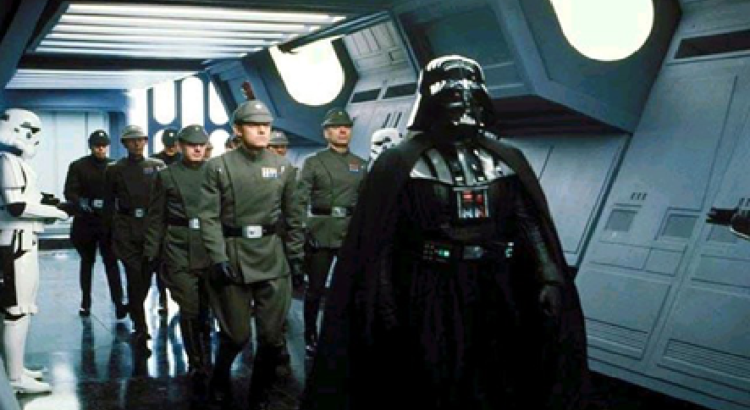
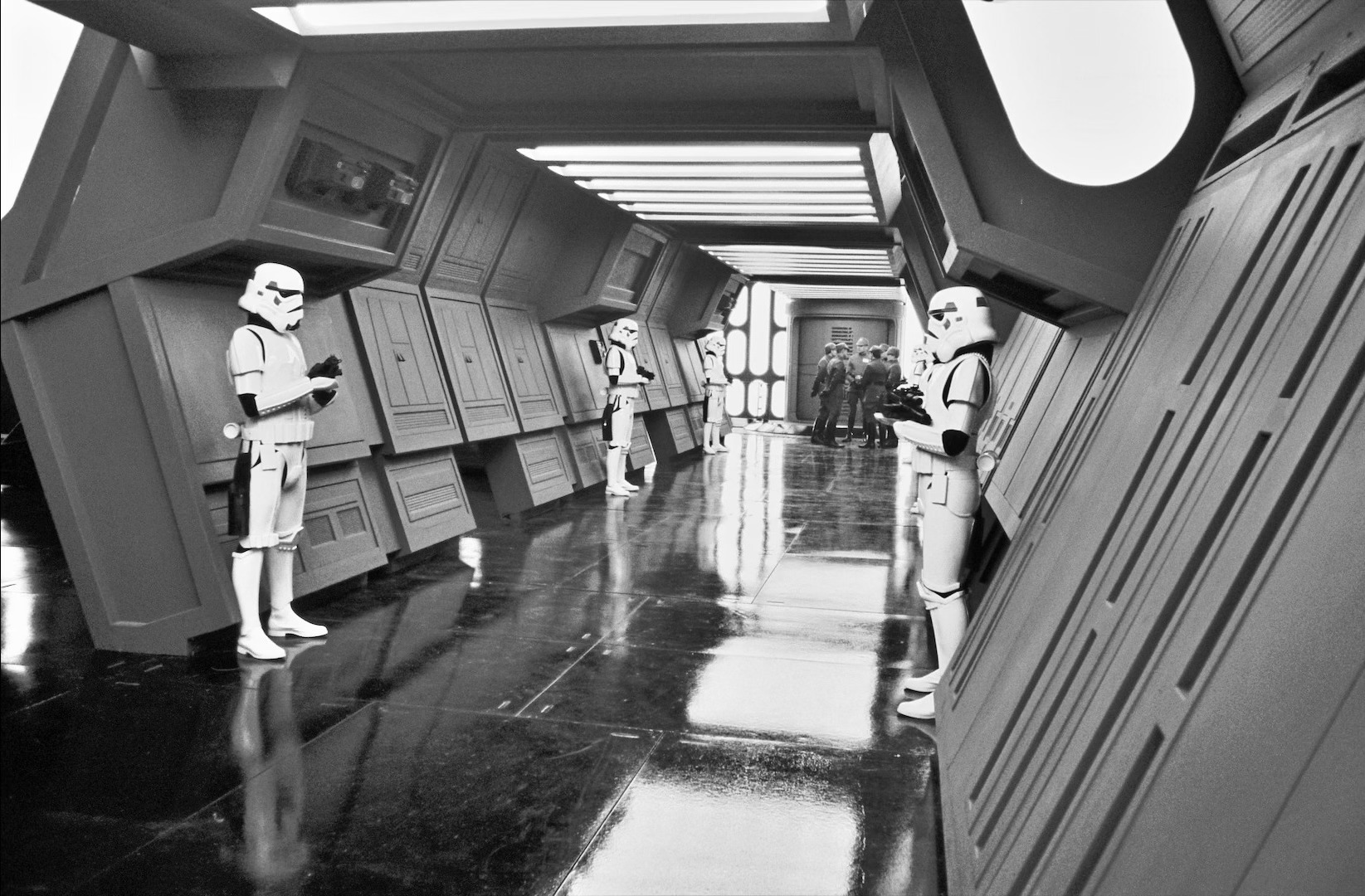
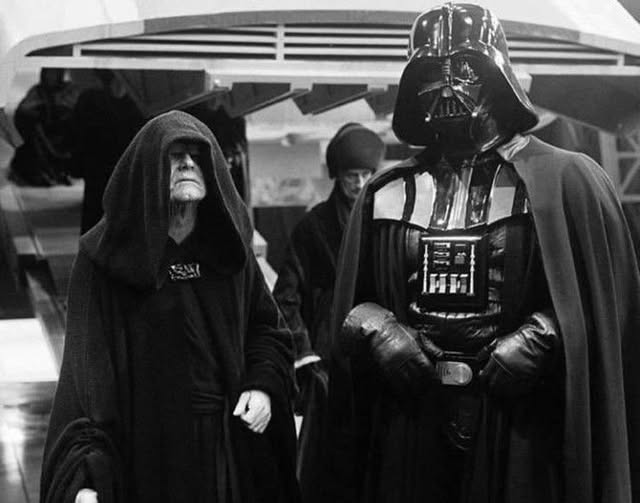
Several sources document a scene with Darth Vader and some officers, including Moff Jerjerrod, travel down a long hallway on their way to greet the arriving Emperor Palpatine.
This scene is described as Scene #47 in the book The Making of Return of the Jedi. Here’s the description from page 145:
47 INT. DEATH STAR – CORRIDOR TO DOCKING BAY
Lord Vader strides down the hallway accompanied by a phalanx of Imperial brass, including a very nervous Death Star Commander.
We can assume that the Death Star Commander is Moff Jerjerrod.
In the novelization, the scene is almost the same:
Darth Vader watched their approach on the view-screen in the control room of the Death Star. When docking was imminent, he marched out of the command center, followed by Commander Jerjerrod and a phalanx of Imperial stormtroopers, and headed toward the docking bay. He was about to welcome his master.


Clip of Vader greeting the Emperor as seen in an early trailer
MOFF JERJERROD
In the early drafts, Jerjerrod had an expanded role as a rival to Darth Vader in the Emperor’s eyes. Vader had failed to capture Luke, and while Vader was his apprentice, the Emperor was less than thrilled with his performance. In the early drafts, Jerjerrod was, in effect, the Emperor’s counsel, much like Tarkin. As a result, Vader was very jealous of Jerjerrod. The Moff was also not as nervous and cowardly as he seemed to be in the film. In fact, he mouthed off to Vader quite a few times. There was always an air of competition between the two. Moff Jerjerrod did prove to have something akin to a conscience, however. There’s one scene where Jerjerrod is a bit conflicted when asked to carry out the Emperor’s order to fire the Death Star.


MORE CHOKING
There are a few deleted bits about Darth Vader trying to seek an audience with the Emperor. One scene takes place after Leia meets Wicket on Endor. Vader gets to the turbolift, but is halted by two of the Emperor’s royal guards. According to an early draft of the script, Vader uses a mind trick, along with some choking, to get what he needs:
INT DEATH STAR – CORRIDOR TO EMPEROR’S TOWER
Darth Vader walks down the corridor to the Emperor’s Tower and private elevator. The Emperor’s private guard steps in Vader’s path.GUARD
Halt! The Emperor does not wish
to be disturbed at the moment.VADER
(raising his gloved hand to the two
guards and choking them with the Force)
The Emperor will see me, now!GUARD
(repeating Vader’s command)
The Emperor will see you, now.
In the book The Making of Return of the Jedi, this scene is labeled as Scene 70 and was shot on February 19, 1982. Here’s the description:
Scene 70 is the corridor to the Emperor’s tower and the Elevator and is three lines of dialogue long. An officer tells Vader that he cannot enter. Vader chokes him and convinces him that Vader should, indeed, see the Emperor.
That matches up perfectly with the script excerpt above except the book says it’s an officer being choked, not a guard. The book goes on to mention the reason why this scene was eventually deleted on page 146:
November: 1982, San Rafael. According to Howard Kazanjian, Scene 70 has now been cut from the picture, partly because of the running time and partly because it doesn’t move the action along. The scenes of Vader choking people are now almost classics, but Kazanjian says that there are lots of other scenes to make up for this one.
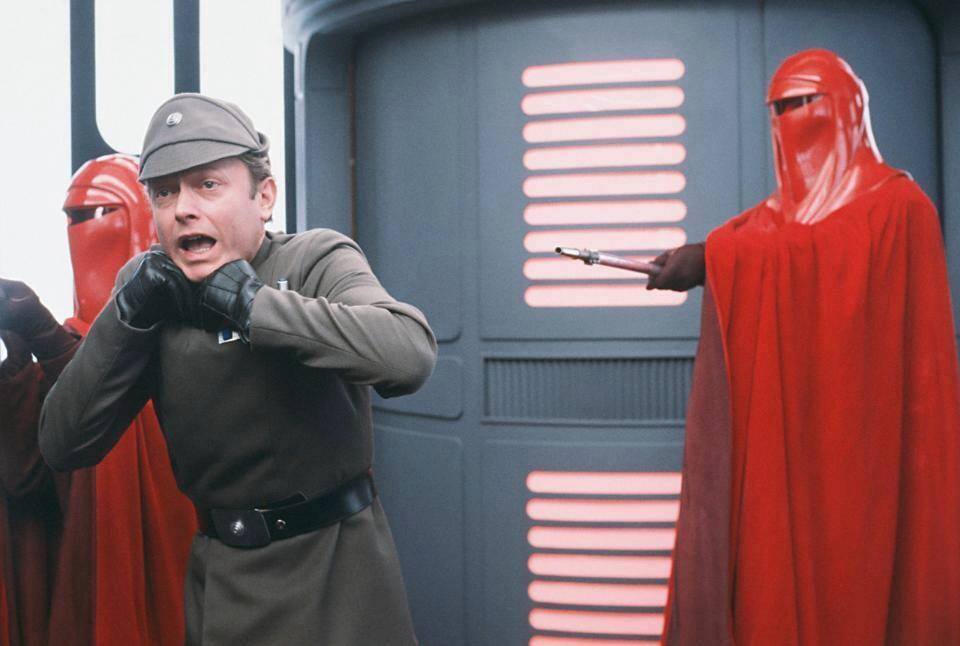
The Scene 70 described in the book (sometimes listed as Scene #68 in certain drafts of the script) matches the novelization. However, Vader uses the force on an Imperial officer instead of a guard, though some guards are present. The officer in question is Moff Jerrjerrod, based on media that has since been released. Here is the passage from the novelization:
When he reached the elevator to the Emperor’s tower, he found the door closed. Red-robed, heavily armed royal guards flanked the shaft, seemingly unaware of Vader’s presence. Out of the shadow, an officer stepped forward, directly in Lord Vader’s path, preventing his further approach.
“You may not enter,” the officer said evenly.
Vader did not waste words. He raised his hands, fingers outstretched, toward the officer’s throat. Ineffably, the officer began to choke. His knees started buckling, his face turned ashen.
Gasping for air, he spoke again. “It is the…Emperor’s…command.”
Like a spring, Vader released the man from his remote grip. The officer, breathing again, sank to the floor, trembling. He rubbed his neck gently.
“I will await his convenience,” Vader said. He turned and looked out the view window.
Starwars.com posted an image from this scene with the caption: “In a scene cut from Return of the Jedi, Darth Vader (off-screen) is denied access to the Emperor’s throne room by Moff Jerjerrod (Michael Pennington) and a pair of Imperial Royal Guards.”



THE EMPEROR’S MINIONS & DARK SIDE DROIDS
When the Emperor came aboard the second Death Star, he brought with him a select group of advisors and creepy cohorts. In 1983, they were just extras and not meant to be important. After the Star Wars Expanded Universe became a thing, Lucasfilm started to go back to all of these secondary characters and give them names and back stories. Over at Starwars.com, in one of their Q&A sessions, this question was asked:
In Return of the Jedi, who are the gentlemen that exit the shuttle with Emperor Palpatine?
The answer:
Accompanying Emperor Palpatine in several scenes is a cadre of Imperial advisors. They are alternately known as Imperial dignitaries, or more sinisterly, the Emperor’s Inner Circle. They wear burgundy and purple robes and have pale skin and sunken features. Many of them are key officials in the managing of the Imperial bureaucracy. Among the members of Palpatine’s Inner Circle are: Sate Pestage, Janus Greejatus, Sim Aloo, Ars Dangor, and Kren Blista-Vanee.
Some of the images you see here are publicity shots and artwork, but they’re fun, nonetheless.




UNUSED CONCEPT: THE IMPERIAL CITY
 The world we now know as Coruscant went through many iterations before finally showing up at the end of the Episode VI Special Edition. It was originally supposed to play a bigger role in those first films. Known by the crew as the “Imperial City,” it went through numerous name changes, the most well-known being Alderaan (before it was repurposed as Leia’s home planet). Another lesser known name was Had Abbadon. Lucas eventually decided to adopt the name Coruscant from the Expanded Universe, first named by Timothy Zahn.
Ralph McQuarrie, in an interview with Starlog Magazine (October, 1983) talks briefly about his contributions to the Imperial City:
“But, the biggest thing left out of RETURN OF THE JEDI was the planet for the rebels [sic]. We worked on this Imperial City a long time, but it’s never visited in the film. George decided to just have everything take place in space. It’s elaborate and quite pretty. But I don’t want to reveal what it looks like because George might use it in the future.”
In the book, Star Wars: The Annotated Screenplays, Lucas talks about why we never saw the Imperial City in the original version of Episode VI:
“In the end it didn’t seem necessary to show the home planet of the Empire. It seemed more important that we focus on the major target of what we were going after in the movie. So to show Vader and the Emperor in an area that didn’t relate to the story didn’t seem necessary. Of course, I had a million different names for the home planet of the Empire, but Coruscant came out of publishing.”
Another original concept that was dropped was the revelation of Vader’s home on the Imperial city planet. In Star Wars: The Annotated Screenplays, Joe Johnston recalls:
“When we were doing [Jedi], I remember I had done a series of sketches of Vader’s home, and there was a sea of lava that his house looked out on. I remember having trouble drawing it because everything was either orange or a shadow; it was very intense. But before we got too far, George said he would save this for somewhere down the line, and I stopped working on it.”
In the film, the Emperor came out of seclusion to the Death Star II, his base of operations for the second half of the film. However, in the original drafts, Luke was brought before Palpatine on the Imperial home world. His “office” was located far below the surface, deep within the planet’s lava caves.
In Star Wars: The Annotated Screenplays, artist Ralph McQuarrie sheds a little light on the original idea:
“The Emperor was going to be in a cave surrounded by lava. The throne room was down in the lower levels of what turns out to be the Empire’s headquarters planet. I imagined it to be dark and spooky with enormous buildings and a metal surface and, down below, huge avenues like on Wall Street in Manhattan. George stated that he wanted a planet that was a city with endless built-up areas. In my mind it was built a thousand years ago, layer after layer. The Emperor’s office would be at the bottom of it, so far down that you would have lava.”
Starwars.com took it a little further:
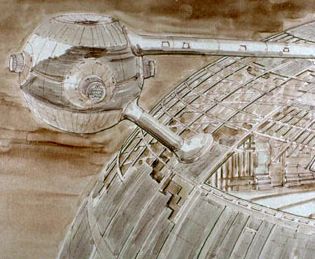
In its earliest incarnation, the Emperor’s throne room was not aboard the Death Star at all, but rather deep below a palace on the capital world, overlooking a lake of lava. An early sketch of the exterior of the second Death Star had the Emperor’s throne room as a contained sphere held away from the station by two bracketing arms. In another early sketch, the throne was suspended from above by a thick cylindrical arm. Other art showed the throne in a central elevated disk connected by a bewildering array of curving catwalks.